Biodiversity Lab · New paper / Landscape Ecology
Can ecological networks also help alien plants?
Connectivity is essential for conservation. But a corridor is not automatically beneficial simply because it connects habitat. Our new study shows why network position, habitat amount and fragmentation need to be considered together.
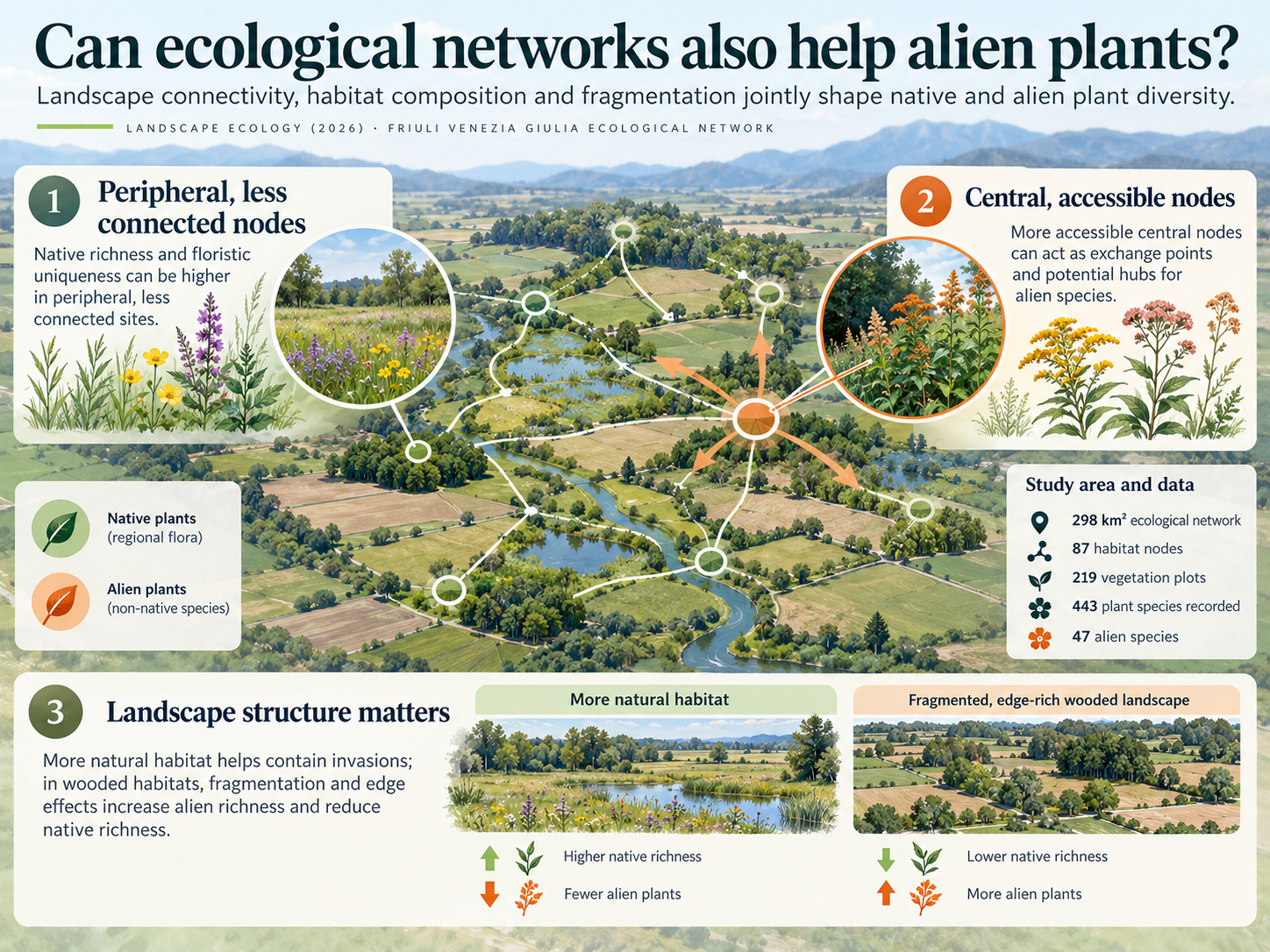
Ecological networks are designed to reconnect fragmented landscapes and facilitate movement among habitat patches. That principle is central to modern conservation planning. Yet the same connections can also influence alien species.
The important point is not that connectivity is “bad”. It is that connectivity does not operate in isolation. The ecological outcome depends on network position, the amount of natural habitat surrounding a site, patch configuration, edge effects and habitat type.
Our new paper in Landscape Ecology, developed with colleagues at the University of Udine, tests these interactions directly in a real ecological network in the lowlands of Friuli Venezia Giulia.
What we found
Peripheral nodes can act as native refugia.
Native and alien plant communities did not respond to the landscape in the same way. Peripheral, less accessible nodes supported higher native species richness and greater floristic uniqueness. These sites can therefore make an important contribution to maintaining distinct native plant communities across the network.
More central and accessible nodes showed different patterns for alien assemblages. Rather than a simple increase in alien richness with connectivity, the study found that connectivity was associated with the composition and uniqueness of alien communities. In practical terms, highly accessible nodes may receive propagules from multiple sources and can become important locations for monitoring and early detection.
Higher native richness and floristic uniqueness.
Greater exchange opportunities and distinctive alien assemblages.
Landscape structure
Natural habitat and fragmentation matter as much as the network itself.
A higher proportion of natural land use around sampling sites was associated with lower alien species richness and higher native richness. This is a particularly useful result for planning because it shows that ecological networks cannot be designed as lines and nodes detached from the landscape matrix around them.
The effect of fragmentation was especially clear in wooded habitats. Greater edge development was associated with lower native plant richness and higher alien richness. In other words, a connected forest patch can still be vulnerable if it is highly fragmented or dominated by edge conditions.
From results to management
A good ecological network is not simply the one with the most connections.
Connectivity remains a fundamental conservation objective, but the study argues for evidence-based network design. Highly connected nodes should be conservation priorities and, at the same time, priority areas for alien-species monitoring and early detection.
Management also needs to be habitat-specific. In wooded landscapes, reducing edge effects and maintaining semi-natural buffers can lower invasion risk. In meadows, network connectivity can play a particularly important role in shaping community composition.
More broadly, shifting from intensive land uses toward more extensive management and well-designed green infrastructure can create a genuine win–win: supporting native biodiversity while making landscapes less favourable to alien establishment.
Take-home message
Ecological connectivity should be planned together with habitat quality, landscape composition and fragmentation — and with explicit attention to alien species.