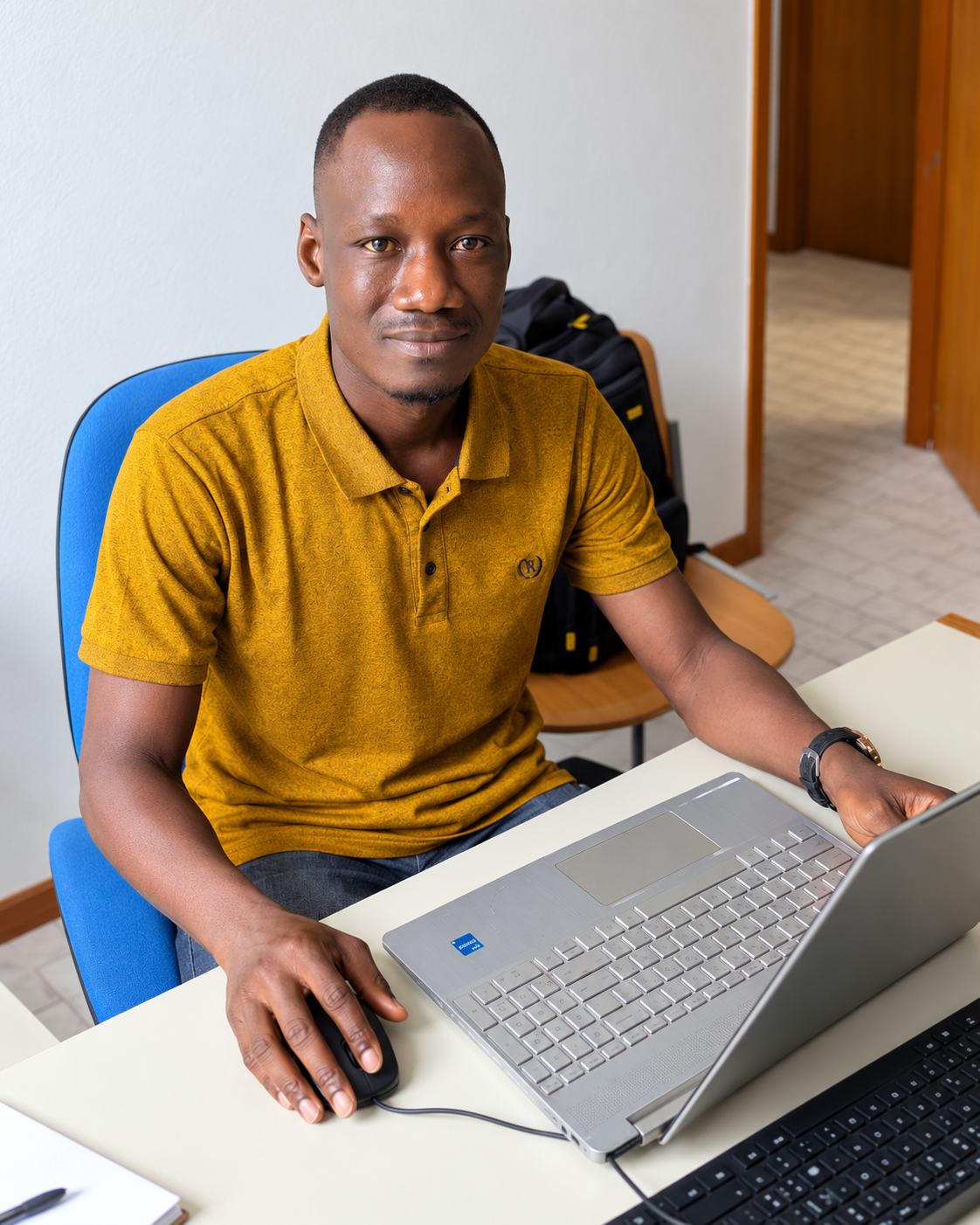
Biodiversity Lab welcomes Idrissa Sawadogo to the Department of Life Sciences at the University of Trieste for a three-month research stay within the TWAS–SISSA–Lincei Research Cooperation Visits Programme.
Idrissa is a PhD candidate in Climate Change and Biodiversity at the African Centre of Excellence on Climate Change and Biodiversity (ACE-CCB/WASCAL), Université Félix Houphouët-Boigny, Côte d’Ivoire, and a research affiliate of the International Livestock Research Institute (ILRI) in Senegal. His work focuses on Sahelian rangelands, forage biodiversity, pastoral systems and climate-change adaptation, integrating field ecology with remote sensing, GIS and ecological modelling.
During his stay in Trieste, the research will focus on species-distribution modelling in rangeland systems, with Diodia scandens as an initial focal species. The work will combine occurrence data with climatic, topographic, soil and human-pressure variables to identify potentially suitable areas and to understand how environmental drivers shape current distributions.
A central objective is to move beyond present-day patterns and examine how suitable areas may change under future climate scenarios. Particular attention will also be given to anthropogenic disturbance and grazing pressure, allowing the modelling framework to connect biological invasions and problematic plant expansion with the wider dynamics of pastoral landscapes.
The visit builds on Biodiversity Lab expertise in spatial ecology, Earth observation and predictive ecological modelling, while bringing into the group Idrissa’s direct experience of West African rangelands and pastoral systems. The collaboration is intended to generate a transferable workflow for identifying areas at risk, supporting monitoring and informing future management and early-warning strategies.
Beyond the immediate research objectives, the visit is also an opportunity to strengthen institutional relations between the University of Trieste and Idrissa’s home academic network. During the coming months we aim to explore bilateral agreements, including the development of a possible Memorandum of Understanding, as well as future joint research, researcher mobility, advanced training and project-development activities.
The TWAS–SISSA–Lincei programme is specifically designed to support three-month collaborative research visits in Friuli Venezia Giulia and to catalyse durable scientific links between researchers and institutions. For Biodiversity Lab, this visit therefore represents both a focused research collaboration and another step in building long-term scientific partnerships with institutions working on biodiversity and global-change challenges in Africa.