Sustainable Coffee Tanzania
Towards the next generation of sustainable quality coffee producers in Southern Tanzania is a 36-month international-cooperation initiative working across Mbeya, Songwe and Ruvuma to strengthen a sustainable, innovative and climate-resilient coffee value chain.
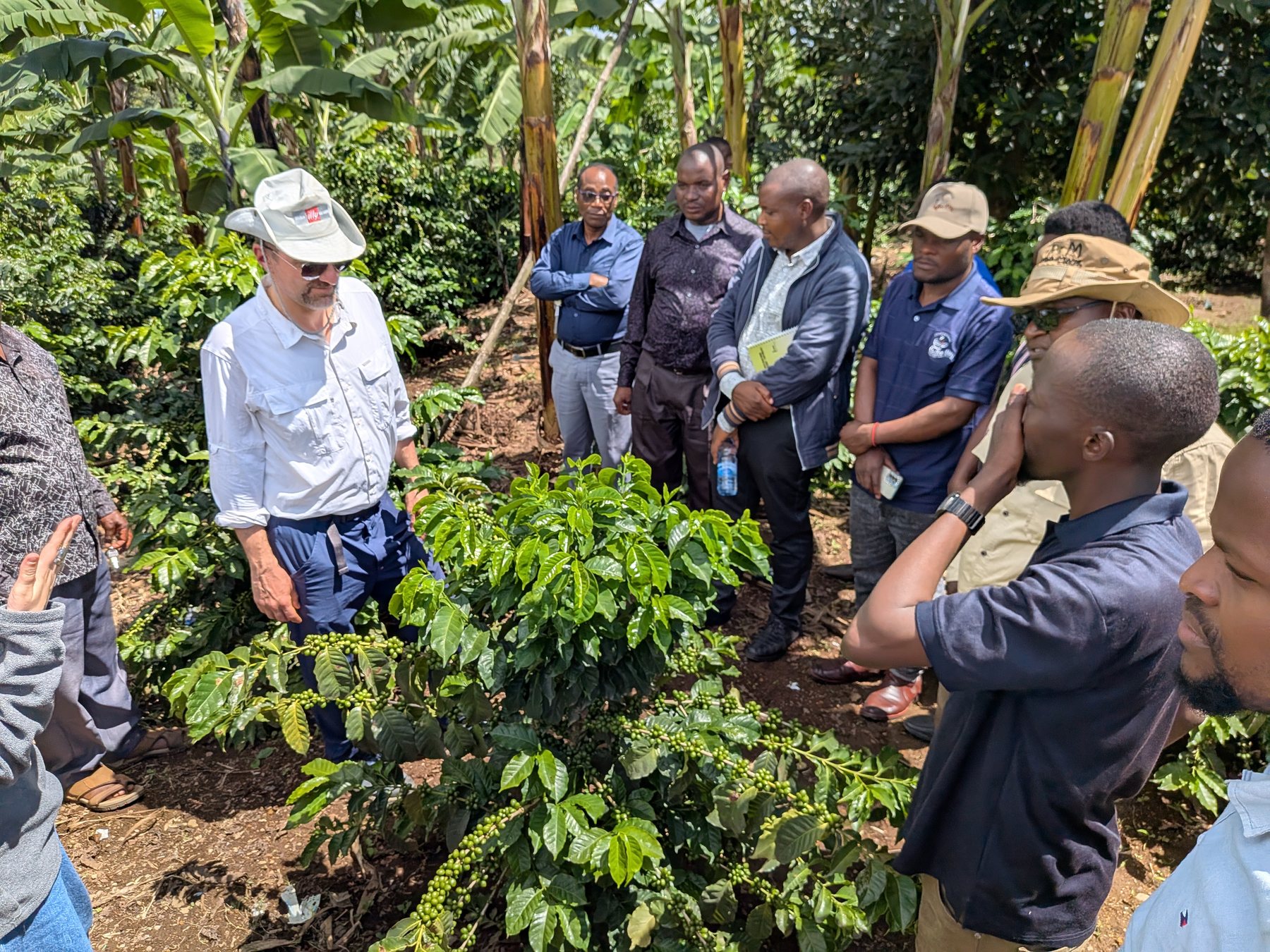
A sustainable coffee value chain built around people, ecosystems and knowledge.
The initiative responds to interconnected challenges affecting coffee production in Southern Tanzania: limited access to advanced training and extension services, ageing coffee plants, low productivity, water use and wastewater management, climate stress, pests and diseases, and the need to create stronger opportunities for young people and women in rural areas.
The project combines training, capacity building, research, infrastructure and technology transfer. Its aim is to improve coffee quality and productivity while supporting sustainable land and water management, climate adaptation, local entrepreneurship and stronger links among producers, cooperatives, public institutions, universities and technical partners.
Understanding where coffee can persist — and how production can support biodiversity.
Giovanni Bacaro coordinates and serves as research reference for the Department of Life Sciences contribution. Within the wider University of Trieste programme, Biodiversity Lab focuses on the ecological, environmental and spatial components of the project.
Spatially explicit models of current and future suitability for coffee species and cultivars, integrating ecological and climatic requirements with land use and future climate scenarios.
Assessment of plant and animal diversity associated with different cultivation systems, including pollinators, agroecological functions and ecosystem-service dimensions.
Geographic analysis, field observations and spatial data support the mapping of production areas, environmental constraints and future adaptation options.
Scientific coordination, research fellowships, training and collaboration with Tanzanian universities strengthen local capacity for botanical, ecological and environmental research.
Ecology is one component of a broader research programme.
UniTS contributes through complementary expertise across Life Sciences, economics and sustainability, and linguistic and anthropological research. Planned activities include genetic characterisation of local coffee cultivars, analysis of climate suitability, biodiversity and ecosystem services, water-quality and microbiological assessment, sustainable production and circular-economy approaches, and research on local knowledge and traditional coffee practices.
Building the scientific network in Mbeya.
A University of Trieste mission to Mbeya in February 2026 helped refine the research agenda and consolidate local academic partnerships. Meetings at the Mbeya University of Science and Technology strengthened collaboration around botanical, ecological and genetic research, while discussions with the Catholic University of Mbeya opened complementary links for linguistic, anthropological, social and economic activities.
Coffee landscapes, people and production systems.
Images from field visits, local institutions and coffee-production contexts in Southern Tanzania.
Research embedded in international cooperation.
The initiative is led by the Autonomous Region Friuli Venezia Giulia and brings together the University of Trieste, illycaffè, Fondazione Ernesto Illy, CIHEAM Bari, regional authorities in Mbeya, Songwe and Ruvuma, the Tanzania Coffee Board and Café Africa Tanzania. The partnership connects scientific research with training, production, public institutions and local coffee cooperatives.