Nature & Culture / Cross-border cooperation
NO WASTE.
From traditional fibre crops to new ways of thinking about biodiversity, circular use and sustainable destinations.
Improved biodiversity for the waste-free exploitation of traditional crops — bringing ecological research, heritage, local production and environmental education together across the Italy–Austria border.
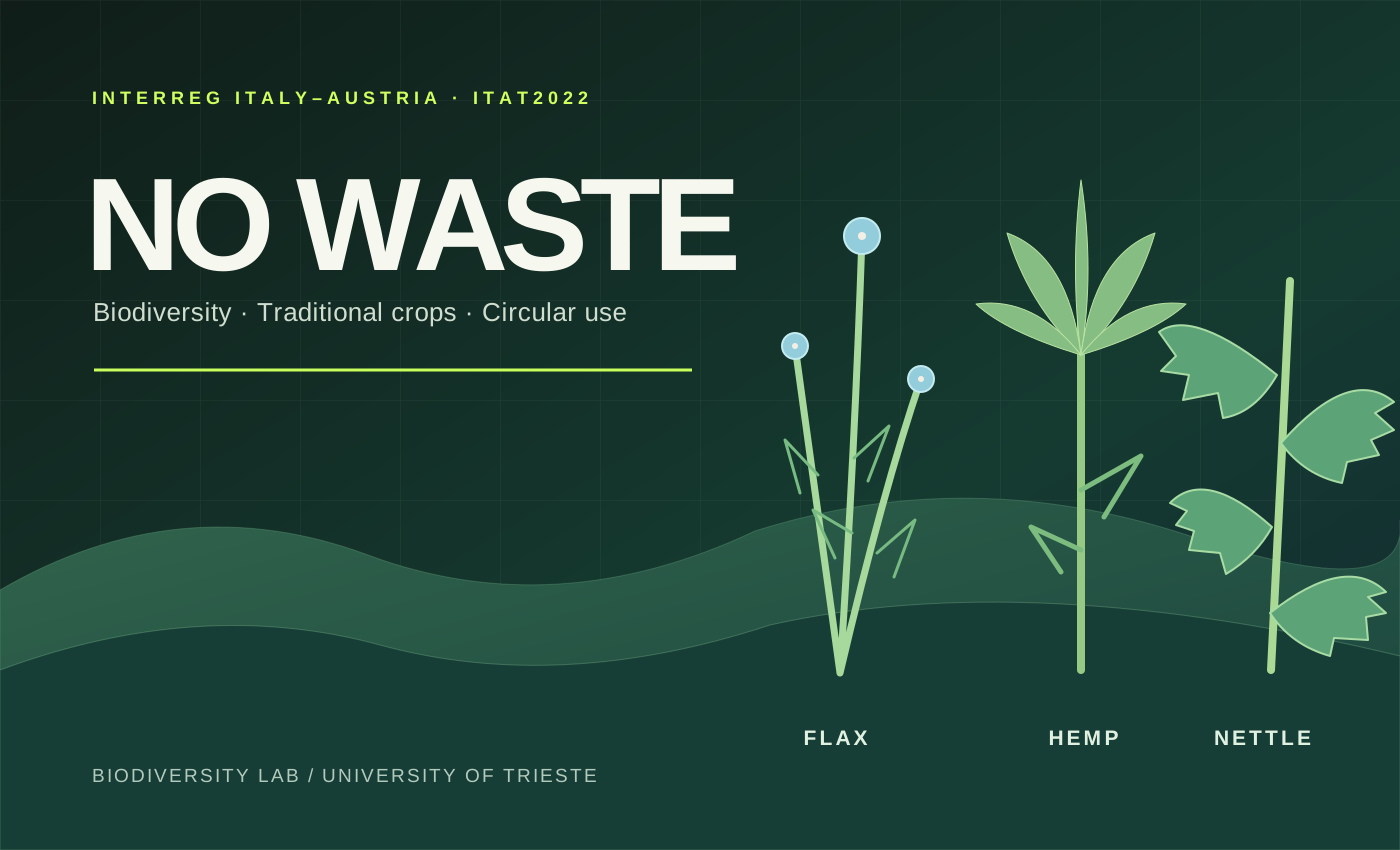
Think beyond the crop. Rethink the entire lifecycle.
Flax, hemp and nettle have been part of Alpine and Adriatic landscapes, manufacturing and local culture for generations. NO WASTE explored what happens when the full potential of these traditional crops is considered together with biodiversity, environmental resources and regional development.
Rather than focusing solely on agricultural production, the project developed a cross-border thematic itinerary that connected landscapes, plant resources, local products and sustainable consumption. Demonstrations, workshops and school activities helped communicate how renewable plant resources can become textiles, paper, food, oils and other products while encouraging more conscious resource use.
For Biodiversity Lab, NO WASTE provided a concrete setting in which ecological knowledge, territorial data and public-facing geographic information could be brought together in an international cooperation project.
Plant diversity as a resource for circular thinking.
Flax
Linum usitatissimumFibres, seeds and a long tradition of cultivation.
A traditional fibre crop that connects agricultural biodiversity with regional material cultures.
Hemp
Cannabis sativaA versatile resource for low-waste value chains.
Crop and by-product valorisation create opportunities across agricultural and industrial supply chains.
Nettle
Urtica dioicaA familiar plant with less familiar material uses.
The project brought renewed attention to an often-overlooked local plant resource.
The three crops were used as examples of traditional plant resources and of potential low-waste product chains. Their actual agronomic requirements and environmental performance depend on local conditions and management.
From ecological information to a territorial story.
Giovanni Bacaro was responsible for the Department of Life Sciences activities concerning biodiversity, plant resources and sustainability. The Trieste contribution connected field-oriented ecological expertise with regional information and the project’s public communication.
Biodiversity and traditional crops.
Scientific input on plant resources, biodiversity and the environmental context of flax, hemp and nettle within their regional landscapes.
Mapping the cross-border itinerary.
Spatial organisation and geographic presentation of the project’s environmental, cultural and territorial information, supporting the thematic route.
A project WebGIS.
The Trieste team developed a WebGIS to communicate geographic information associated with NO WASTE. The historical application is no longer presented as an active service because its original deployment has not been confirmed as available.
Making the project accessible.
Integration of research content with public-facing digital communication. Giovanni Bacaro also coordinated the project website during 2018–2022.
The original WebGIS was developed during NO WASTE but is treated here as an archived project output, not a working online application. Historical screenshots and map layers will be added to this page when the original files are recovered.
Our current GIS & WebGIS services ↗A route, a resource, a shared language.
Cross-border thematic route
A territorial itinerary connecting plant diversity, environmental and cultural heritage, local value chains and sustainable tourism.
Knowledge & education
Project communication and school-oriented activities brought low-waste lifestyles and plant-based material chains into the public conversation.
Digital geographic outputs
A WebGIS and geospatial communication made the territorial dimension of NO WASTE accessible during project implementation.
A platform for later work
Experience at the interface of biodiversity, traditional crops and circular resource use also connects NO WASTE with subsequent collaborations, including SPARE.
Three partners. One cross-border approach.
Certottica
Coordinated the international partnership and project implementation.
Explore our partnership ↗Kompetenzzentrum Holz
Cross-border research and innovation partner connecting regional resources with material and wood-sector expertise.
Explore our partnership ↗University of Trieste
Department of Life Sciences: biodiversity, plant resources, territorial GIS and the historical project WebGIS.
Meet Biodiversity Lab ↗Explore the NO WASTE story.
The project book and Interreg archive document the thematic route and the activities developed by the consortium. Historic field photographs, the group photograph at Rifugio Cercenà and original WebGIS figures can be incorporated here once the appropriate image files are available.
Project archive · 2017–2022