PALLIPES.
The white-clawed crayfish as a sentinel of freshwater ecosystems.
From environmental DNA to habitat suitability and riparian conservation: a joint effort to protect Austropotamobius pallipes across the Italian–Slovenian border.
A threatened freshwater species across a shared river landscape.
The white-clawed crayfish (Austropotamobius pallipes) is a protected freshwater species associated with clean, well-oxygenated streams, suitable substrates and connected riparian habitats. Across the Italian–Slovenian border, populations face habitat degradation, pollution, reduced river flows, invasive non-native crayfish and crayfish plague (Aphanomyces astaci). Climate-driven changes in water availability add further pressure.
PALLIPES combines coordinated cross-border monitoring, environmental DNA (eDNA), ecological modelling and practical restoration to support evidence-based conservation in Natura 2000 areas and adjoining watersheds. The study area includes the Karst–Reka/Timavo system and other freshwater systems in Friuli Venezia Giulia and western Slovenia.
Connecting species records with the habitats that sustain them.
Our group develops the environmental-botany and spatial-ecology component of the University of Trieste contribution. Giovanni Bacaro supervises this work, and Federica Fonda is the research fellow working on habitat analysis and ecological modelling within PALLIPES.
Data integration
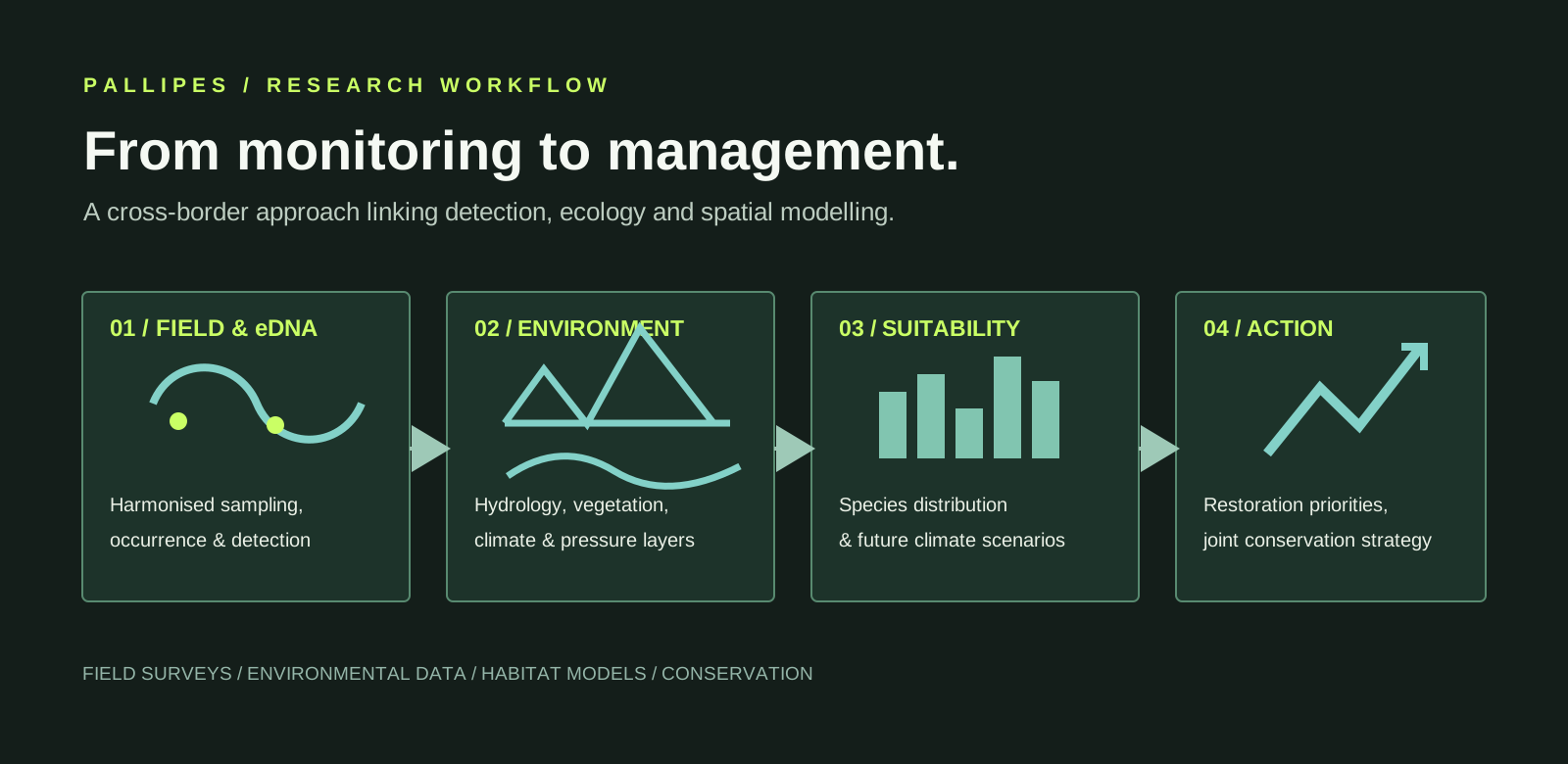
Combine occurrence and detection information, including eDNA outputs from the project’s zoological team, with harmonised field observations and environmental datasets collected by the cross-border partners.
Riparian habitats & GIS
Characterise river corridors, riparian vegetation, land cover, ecological pressures and the landscape context surrounding occupied and potentially suitable stream reaches.
Species distribution models
Develop spatially explicit habitat-suitability models relating the crayfish’s distribution to environmental and hydro-climatic conditions, including the analysis of potential responses under future climate scenarios.
Conservation support
Translate spatial evidence into identification of potentially suitable and vulnerable habitat, restoration priorities, shared reporting and the project’s transboundary conservation strategy.
University of Trieste’s complementary zoological and molecular component, led by Chiara Manfrin, provides eDNA expertise and contributes to standardised monitoring and the shared environmental–molecular database.
Field ecology, eDNA and environmental modelling.
At project level, the coordinated monitoring programme assesses current occurrence and pressures on A. pallipes in the cross-border area. Non-invasive water sampling and molecular analyses strengthen detection, while GIS-based environmental layers and species distribution models provide the wider ecological context. Results are used to inform habitat assessment, joint protocols and practical conservation measures.
Four pilots and one shared strategy.
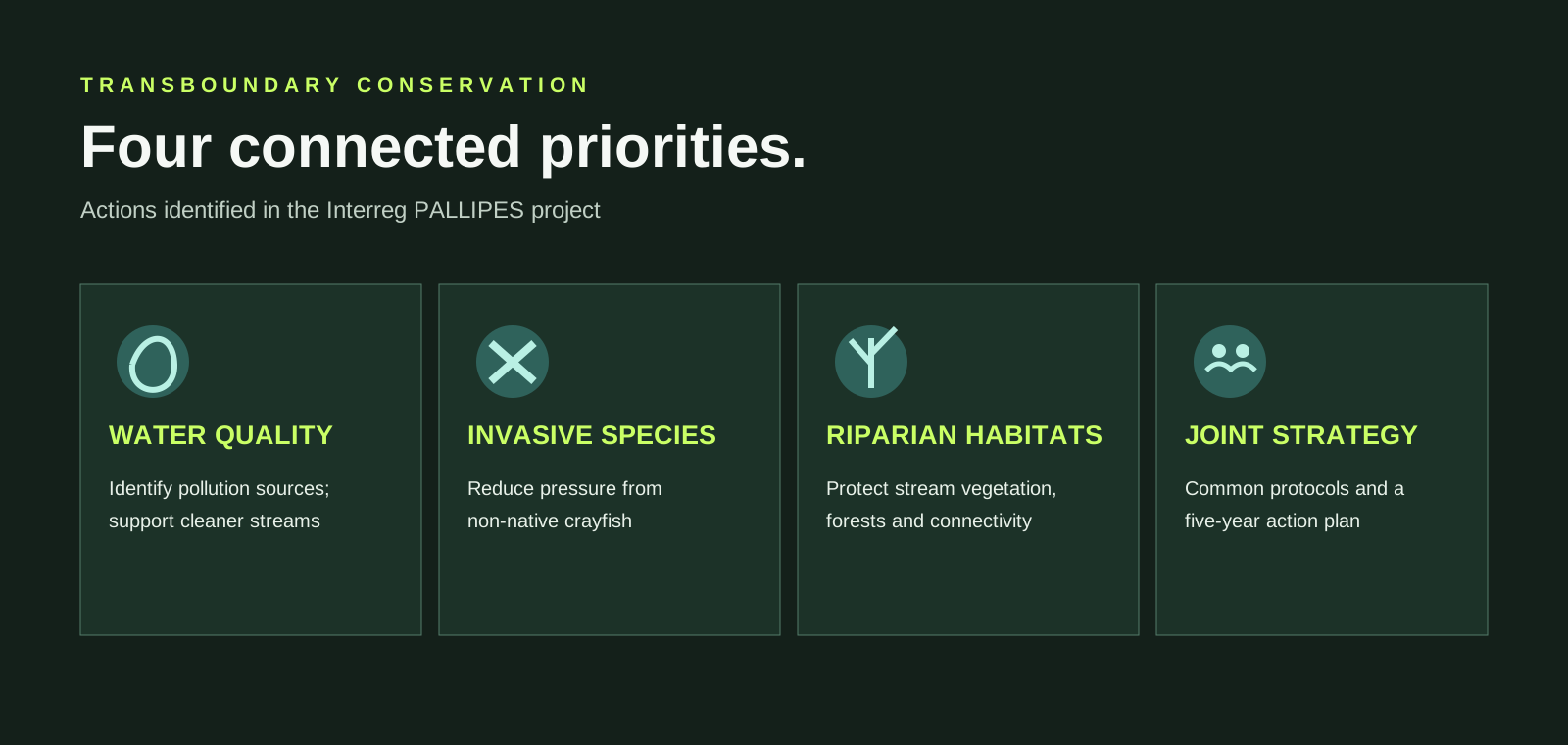
The project supports actions to improve aquatic habitat quality and reduce pressures on native crayfish, including the upgrading of wastewater treatment at Ilirska Bistrica, remediation of illegal dumping sites within the Reka basin, control of invasive non-native crayfish, and targeted freshwater-habitat improvements. These actions complement coordinated scientific monitoring and education initiatives.
The partners are also preparing a joint cross-border conservation strategy and a five-year action plan. The strategy brings monitoring evidence, site-management requirements and restoration measures together across Italian and Slovenian river systems.
Evidence gathered across the border.
According to the project’s published reporting records, the early Slovenian monitoring phase included analysis of 120 water samples and 42 positive locations. Subsequent fieldwork expanded to 52 monitoring stations in Friuli Venezia Giulia, alongside a shared data structure and standardised sampling guidance prepared by UniTS.
Reporting-period figures, not a current estimate of the total number of crayfish populations.Four partners, shared freshwater ecosystems.
Škocjan Caves Park
Department of Life Sciences
Water infrastructure and monitoring
Hunting and fisheries resources service
Associated partners include local administrations, fisheries organisations, water-management institutions and Natura 2000 stakeholders on both sides of the border.
Official project resources.
Project dates and budgets follow the current Interreg project factsheet. The UniTS allocation is reported separately in the University of Trieste’s funded-project portfolio; older launch material and some regional pages show earlier end dates.